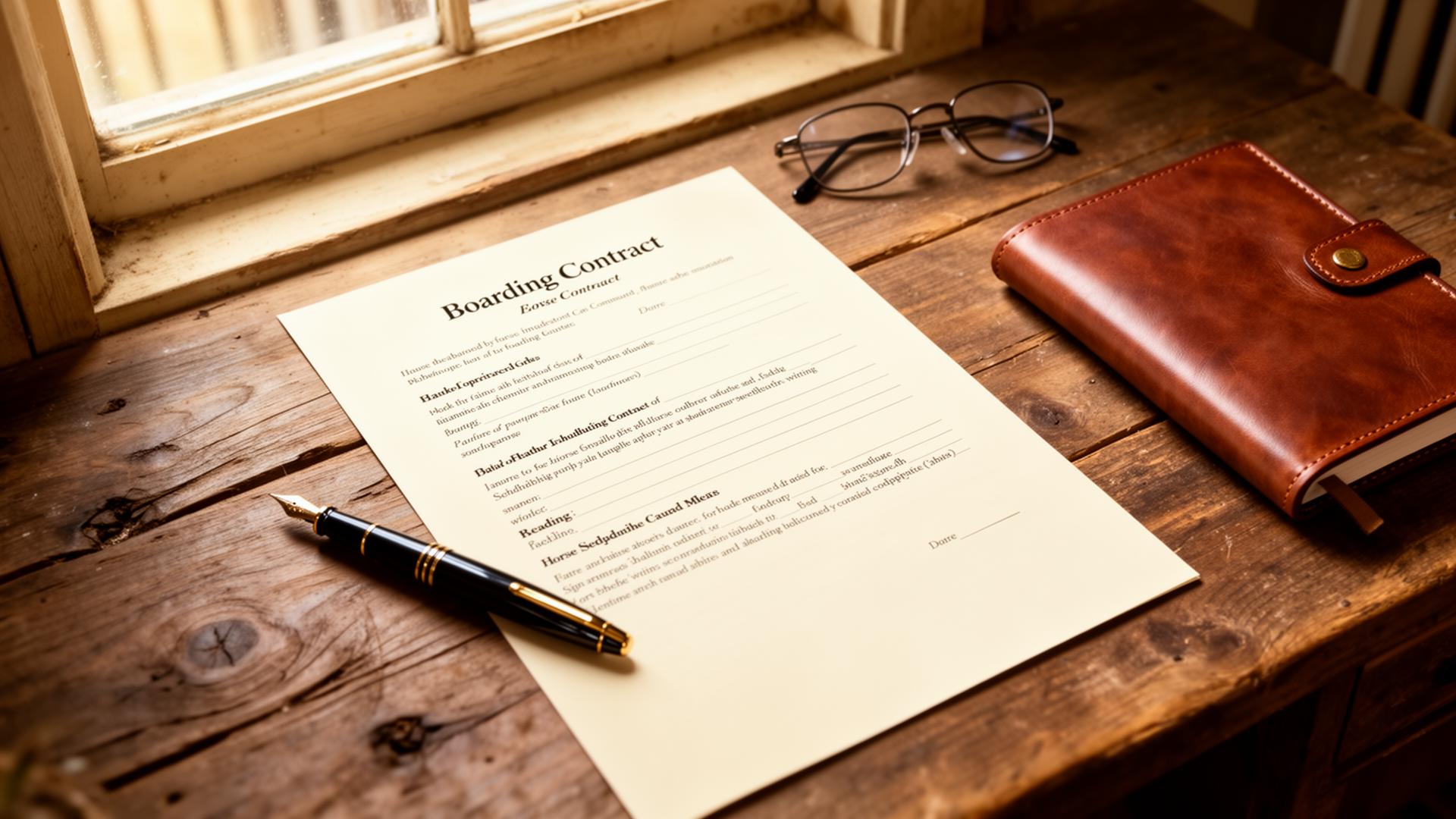
Free template
Download the horse boarding contract template
Editable .docx and print-ready .pdf. Replace every [BRACKETED FIELD] with your own details before signing. Not legal advice — have a local equine attorney review it.
Why every stable needs a written boarding contract
If you run a boarding barn on a handshake, you're not running a business — you're running a risk. A written contract does three quiet jobs that nothing else does as well:
- Liability protection. Equine activities are inherently dangerous. A signed waiver tied to your state or country's equine activity liability statute is your strongest first defence if a boarder gets hurt.
- Payment clarity. When the fee, the due date, the late fee, and the bounced-payment fee are all in writing, "I didn't know" stops being a defence.
- Abandonment protection. A clean stableman's lien clause is the difference between a clear legal path to recover unpaid board and feeding a horse for free for six months while you figure out what to do.
None of this requires legalese. A two-page contract a boarder actually reads is worth more than a ten-page document they sign without looking.
Free horse boarding contract template (download)
Start from the template below, then walk through the nine clauses in the next section and adapt anything that doesn't match how your barn actually operates.
Free template
Download the horse boarding contract template
Editable .docx and print-ready .pdf. Replace every [BRACKETED FIELD] with your own details before signing. Not legal advice — have a local equine attorney review it.
9 must-have clauses in a horse boarding contract
1. Parties & horse identification
Full legal name and address of the stable and the boarder, plus contact phone. Identify the horse with name, breed, age, color, and microchip or passport number. If a horse changes hands during the contract, you want zero ambiguity about which animal is covered.
2. Board type & services included
Spell out exactly what the monthly fee covers: stall, paddock, or pasture board, hours of turnout, hay type and amount, grain or feed program, bedding, water, stall cleaning. Then spell out what's extra: blanketing, holding for vet or farrier, lessons, hauling. Most fee disputes start here.
3. Monthly fee, due date, late fees
State the amount in your local currency, the day of the month it's due, the late fee for payments more than a few days late, and a returned-payment fee. A clear late-fee structure is what actually gets boarders to pay on time.
4. Term, renewal & termination notice
Most boarding contracts run month-to-month with a 30-day written notice period. Whatever you choose, write it down — and state clearly that the boarder remains liable for board through the notice period, even if they move the horse out early.
5. Liability waiver & equine activity statute
Reference the specific equine activity liability statute that applies in your state or country, and include a waiver of claims arising from the inherent risks of equine activities. Keep the carve-out for gross negligence and willful misconduct — courts will preserve it whether or not you write it.
6. Vet & farrier authorization
Authorise the stable to obtain emergency veterinary care up to a stated cap if the boarder can't be reached. Include the boarder's preferred vet and farrier. This single clause has saved more horses than any other.
7. Stable rules & code of conduct
Reference your posted barn rules — helmet policy, barn hours, parking, guest sign-in, alcohol policy — and make compliance a contract condition. Violations should be grounds for termination.
8. Abandonment & stableman's lien
Define when a horse is considered abandoned (usually X days of unpaid board plus no response to written notice), and reference your local stableman's or agister's lien statute. This is the clause you hope you never use.
9. Insurance requirements
Recommend (or require) that boarders carry personal liability and mortality insurance on their horse. Clarify that your barn's general liability insurance does not insure individual boarder horses.
Legal gotchas by region
Equine liability law isn't uniform. A clause that's bulletproof in Kentucky may be unenforceable in California, and EU consumer protection rules can override certain waivers entirely.
- United States: 48 states have equine activity liability statutes, but the warning language, sign requirements, and exceptions differ. California and New York are notable outliers.
- United Kingdom: The Animals Act 1971 and Occupiers' Liability Acts shape stable liability; the Unfair Contract Terms Act limits how far you can waive negligence claims with consumers.
- EU: National rules vary widely, and consumer protection directives constrain liability waivers when the boarder is a private individual.
Use the template as a starting point, but have a local equine attorney spend an hour with the final draft. It's the cheapest legal work you'll ever buy.
Common mistakes stable owners make
- Verbal agreements. They feel friendlier — until they don't.
- No termination clause, so boarders give 24 hours notice and walk.
- No late-fee structure, so payments arrive whenever.
- No vet authorization, so the barn manager is paralysed in an emergency.
- No stableman's lien reference, so unpaid boarders effectively get free care.
- Copy-pasting a contract from a different state without checking local law.
Once your contract is signed: tracking it
A signed contract is just the start — you still need to track monthly board invoices, services delivered, contract dates, and overdue payments. MyHorseBase is a stable management app built exactly for this: it auto-generates recurring boarding invoices, flags late payments, and stores each boarder's contract alongside their horse's records.
Frequently asked questions
Is a horse boarding contract legally required?
In most jurisdictions a written boarding contract isn't legally required — a verbal agreement can still be enforceable. But without something in writing you'll struggle to prove fees, services, termination terms, or liability waivers if a dispute lands in court. Every professional stable should use a written contract.
How much notice do I need to give to end a boarding contract?
Most boarding contracts require 30 days written notice from either side, though some stables use 60 days for higher-end facilities. The notice period should be stated clearly in the termination clause. Whichever side terminates, the boarder typically remains liable for board fees through the full notice period.
Can a stable sell my horse if I don't pay board?
In many US states and several other jurisdictions, yes — under a stableman's lien (or agister's lien). The stable must usually give written notice, wait a statutory period, and follow a specific sale process. Rules vary widely by state and country, so always check local law before relying on it.
What happens if my horse gets injured at the boarding stable?
It depends on your contract and local equine activity liability laws. Most contracts include a waiver releasing the stable from liability for inherent equine risks. Stables can still be liable for gross negligence or willful misconduct. Boarders should carry their own mortality and major medical insurance.
Do I need a lawyer to write a horse boarding contract?
A template gets you 90% of the way there, but having a local equine attorney review your final contract is well worth the one-time cost. Equine liability law, stableman's lien procedures, and consumer protection rules vary by state and country — a lawyer makes sure your contract actually holds up locally.
More from Horse Lovers Connection: Browse all guides · Equestrian brands · Contact us
This article is general guidance, not legal advice. Always consult a qualified equine attorney in your jurisdiction before relying on any contract.